Reject Turning Budgets into Tools for Political Retaliation!Reject Turning Budgets into Tools for Political Retaliation!
發布日期 2025.09.30
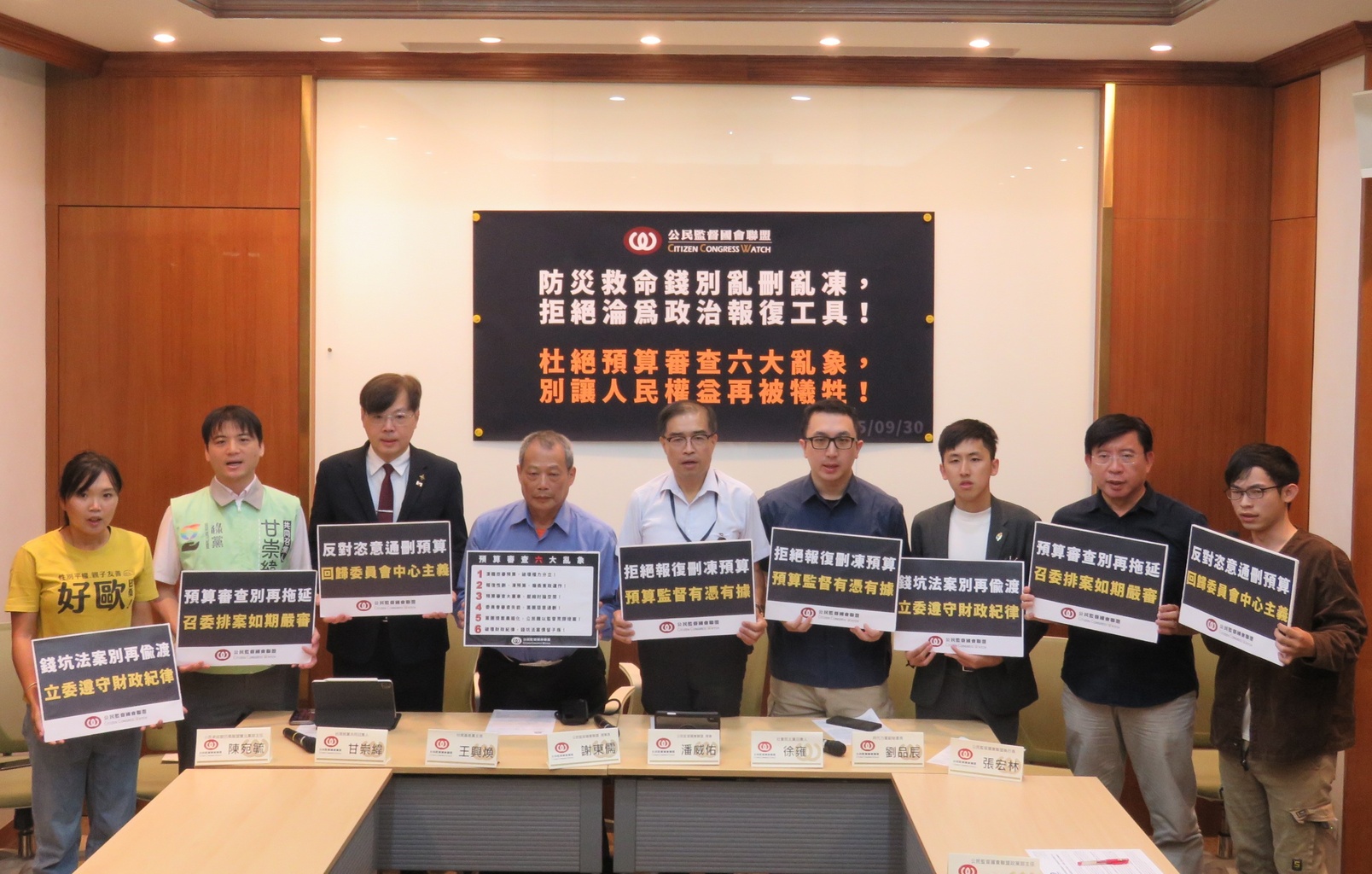
Don’t Arbitrarily Slash or Freeze Life-Saving Disaster Relief Funds — Reject Turning Budgets into Tools for Political Retaliation!
End the Six Major Budget Review Abuses — Don’t Let the Rights of Citizens be Sacrificed Again!
Recently, the overflow of the Matian’an River landslide lake in Hualien caused severe disaster in Guangfu Township. Citizens across Taiwan have united in rescue and reconstruction efforts to minimize the damage caused by this extreme natural disaster and help victims return to their normal lives as soon as possible. Whether it’s military personnel, police and firefighters, disaster prevention specialists, administrative systems, or volunteers, all have played crucial roles on the frontlines. However, the success of disaster recovery and long-term reconstruction efforts is closely tied to whether next year’s central government budget can be rationally reviewed and approved in the Legislative Yuan.
Hsieh Tung-Ju, Chairperson of Citizen Congress Watch (CCW), stated: “It’s been over a week since the Hualien flood disaster. During this time, the whole nation has pitched in to help the residents of Guangfu Township stand back up. This unity has brought warmth to the victims’ hearts. In stark contrast, political parties continue their meaningless and disheartening squabbling. With the central government’s total budget exceeding 10 trillion NTD (3 trillion for general government operations and over 7 trillion for affiliated agencies), if opposition legislators continue to use the budget review as a tool for political retaliation, could seriously impact important social welfare policies. Therefore, CCW, along with the Taiwan People’s Party, Taiwan Statebuilding Party, Taiwan Green Party, Taiwan Obasang Political Equality Party, and Social Democratic Party, jointly held a press conference to solemnly remind all legislators — including committee chair candidates and Legislative Yuan President Han Kuo-Yu —that the budget session is about to begin. We urge the Legislative Yuan not to repeat past mistakes and allow budget review to become a tool for political infighting!”
CCW and Five Minor Parties Urge: Keep Budget Reviews Professional — Avoid Repeating the Six Major Abuses!
Pan wei-yiu, CCW member and Chair of the Taiwan Teachers’ Alliance, emphasized: “Budget reviews are the foundation of a constitutional democracy. Yet, during the 2024 review, problems such as procedural delays, lack of negotiation, arbitrary freezes and cuts, and excessive proposals emerged repeatedly. Some opposition lawmakers even proposed cutting government agency ‘operating expenses’ to just 1 NTD — a move that sparked widespread criticism. In civic education, we teach students that democracy is about rational debate, institutional processes, and public accountability. Yet, the Legislative Yuan has set a terrible example by using budget reviews for political retaliation rather than performance- and data-driven oversight founded in public interest. Therefore, before the next budget review session begins, we solemnly remind all parties: put the public’s rights and interests first; Rebuild trust in parliamentary politics.”
Abuse 1: Dereliction of Duty — Refusing to Review the Budget Undermines Checks and Balances
Chairperson of the CCW, Hsieh Tung-Ju, pointed out that during last year’s review, both the KMT and TPP rejected the entire central budget six times in protest over the allocation of “indigenous community logging compensation funds.” This year, with similar disputes looming on the horizon, KMT legislators have already threatened to reject the 2026 budget. CCW emphasized that legislators, as public servants, must fulfill their constitutional duties. Citizens expect Parliament to be a place for policy debate — not political sabotage. Therefore, budget reviews should undergo proper to legislative procedures and transparently examine whether allocations are reasonable. Malicious obstruction only prevents important public projects from advancing, thus harming the interests of all citizens.
Abuse 2: Retaliatory Budget Cuts and Freezes That Paralyze Constitutional Governance (Budget oversight must be evidence-based!)
Wang shin-huag, Chair of the Taiwan Statebuilding Party, criticized: “Last year, the KMT–TPP were a complete failure in the Legislative Yuan’s budget review. They not only maliciously blocked the general budget in the Procedure Committee, but also retaliatorily cut and froze executive agencies’ operating expenses, deliberately paralyzing government operations and laying bare severe dysfunction in parliamentary proceedings. He stressed that the central government’s general budget is the cornerstone of national governance and must not be manipulated by political parties. The people merely rejected one-party dominance by the ruling party and put the opposition’s oversight ‘on probation’; they did not grant it ‘unlimited power’.” He urged the KMT and TWP to “stop enacting retaliatory budget cuts and wasteful spending bills, learn to respect the constitutional order, and act as an opposition party truly committed to the people's welfare, not as agents of foreign powers!”
According to Article 49 of the Budget Act, budget deliberations should focus on the scale of expenditures, program performance, and priorities. Legislators should not make arbitrary, sky-high demands. CCW calls on committees to strengthen their review of the National Audit Office’s final accounts reports so that budget oversight has a solid base.
Abuse 3: Budget review gridlock that squeezes out deliberation time! (We’re calling on committee chairs to actively schedule budget review items!)
CCW Executive Director Chang Hung-Lin stated: “According to Article 51 of the Budget Act, the central government’s general budget should be approved by the Legislative Yuan one month before the start of the fiscal year (that is, by the end of November), so that agencies have sufficient time for advance preparation and can implement their policy plans the following year. Yet it’s already late September today, and the Legislative Yuan still hasn’t gotten moving—are they trying to let last year’s turmoil over the general budget review play out again?”
Chang Hung-Lin emphasized that this year, during the extended session, the Legislative Yuan failed to make use of the time to handle the FY 2025 (114th year) state-owned enterprise budgets. Next, in the budget session, it will also have to deal with the “Resilience Special Budget” as well as the central government’s FY 2026 (115th year) general budget. Therefore, on the day before the committee chair elections, CCW is making a special appeal to those legislators who will serve as committee chairs: in addition to adhering to the principle of avoiding conflict of interest, they should not deliberately arrange large numbers of inspection trips for show or ram through controversial bills, but instead should return to the core duties of a legislator and actively schedule items to review the budget.
Abuse 4: Committee Paralysis and Blanket Cuts — Return to Committee-centered Deliberation!
New Power Party Deputy Secretary-General Bennett Liu stated: “The Hualien disaster reminds us that the quality of budget review directly affects public safety, yet last year’s general budget was riddled with slapdash proposals and malicious political maneuvering. After the KMT and TPP gained a majority, they rushed through large numbers of low-quality proposals and continued the long-standing bad habit of ‘across-the-board cuts’—shouting only about what percentage to slash without regard for the actual budget line items, then dumping the task on administrative agencies to adjust on their own. He sharply criticized that across-the-board cuts have led executive agencies, when drafting budgets, to simply reserve buffer space in advance, hollowing out the meaning of oversight and reducing it to mere performance. He called on all parties to respect professional discussion in committees, stop blanket cuts and retaliatory proposals, and not let budget review once again become political warfare. It should return to professional, committee-centered budget oversight.”
Abuse 5: Lack of Transparency — Citizens Can’t Monitor Absurd Proposals! (The Legislative Yuan must promptly establish a budget-proposal tracking system)
Chen Wan-Yu, Director of the Obasan Alliance’s Taipei–New Taipei Chapter, believes: “In a democratic parliament, citizen accountability is a crucial link. Last year’s chaos in the general budget review made people realize how closely budgets are tied to everyday life. If the legislature treats the budget as a tool for retaliation, the ones who suffer are disaster-area residents, families needing childcare, youth, and people with disabilities—not the political parties.”
Chen criticized the opaque review process and absurd proposals that left citizens unable to monitor lawmakers. She stressed: the Obasan Alliance supports CCW’s demand that Legislative Yuan President Han Kuo-Yu must build a transparent budget-proposal system in which all cuts and freezes are disclosed in real time, allowing the public to see clearly who is slashing indiscriminately and who is freezing funds. Only then can low-quality budget proposals be eliminated and the parliament’s credibility be rebuilt.
CCW also formally urges Legislative Yuan President Han Kuo-Yu to fulfill his responsibility and swiftly complete the establishment of a budget-proposal query system for public inspection, so that progress toward transparent parliamentary proceedings does not stall.
Abuse 6: Financial Irresponsibility — “Money Pit” Bills Will Burden Future Generations! (Lawmakers should not act like irresponsible “money fairies” who only hand out cash!)
Green Party Taiwan co-convener Kan Chung-Wei stressed that Parliament must not tolerate chaos in budget review—taxpayers’ hard-earned money is not a tool for political struggle! He put forward three demands: (1) establish a public, transparent system for budget proposals; (2) uphold a committee-centered review process; and (3) require justified, evidence-based grounds for any cuts.’
Kan further urged Parliament to stop advancing “money-pit bills” and instead prioritize legislation that truly affects people’s livelihoods, including the Childcare Services Act, the Youth Basic Law, and the People with Disabilities Rights Protection Act, which has been awaiting amendment for 18 years) These are the reforms the public genuinely needs and that merit real effort.
CCW warned that the power of the purse is a core executive function. Yet, recent proposals — from the East Taiwan Special Act, Revenue and Expenditure Division Act, and budget legalization of universal cash handouts to revisions of pension laws, — risk burdening future generations with debt. We therefore call on lawmakers to return to their role of budget oversight: root out wasteful government spending, rather than acting as irresponsible “money fairies” who only hand out cash. These politically contentious bills should be handled according to Article 91 of the Budget Act and Article 5 of the Fiscal Discipline Act: the legislature should first solicit the views of the competent administrative agencies, and clearly specify the source of funds.
No Matter How Ruthless, Don’t Block Life-Saving Budgets! Budget Review Must Be Rational, Scientific, and Practical!
CCW Executive Director Chang Hung-lin emphasized that, judging from this Hualien flood disaster, the current Revenue and Expenditure Division Act—which “divides up the money but doesn’t do the work”—poses a serious threat to Taiwan’s fiscal discipline and the resilience of public policy. After disasters occur, local governments tend to shift responsibility for rescue and reconstruction to the central government, demanding a “big central, small local” model; yet when it comes to dividing up funds, they demand “big local, small central.” This is a clear contradiction. Therefore, we urge that the Revenue and Expenditure Division Act be thoroughly and carefully debated, and even postponed until the year after next before implementation, so as to avoid causing severe disruption to next year’s central and local government general budgets.
CCW Policy Director Chen Li-Yi noted that Taiwan is situated in a high-risk geographic area for natural disasters. Under the Disaster Prevention and Protection Act, the Executive Yuan submits a Disaster Prevention and Protection White Paper to the Legislative Yuan to explain outcomes, budgets, and future strategies. Yet during last year’s budget review, many proposals by KMT legislators—without even reading the White Paper—merely justified slashing or freezing disaster-prevention budgets under the banner of “cutting costs”, including: a proposal to freeze 30% of the Airborne Service Corps’ operating expenses; deleting the budget for meteorological rainfall monitoring equipment (Legislator Lai Shyh-bao); freezing the earthquake monitoring and reporting budget (Legislator Huang Jen); and cutting NT$100 million from firefighters’ protective equipment (Legislator Wang Hung-Wei). Although most of these proposals were later voluntarily withdrawn, they only further highlighted the absurdity of this budget review.
Chen stressed that long-term flood control and disaster-prevention engineering cannot rely solely on the first and second reserve funds as emergency stopgaps. A more macro, longer-term approach to disaster prevention and mitigation ultimately requires stable funding through annual central government general budgets. CCW calls for every budget review to return to rationality, science, and pragmatism—do not let disaster-prevention and livelihood budgets become casualties of political infighting.
CCW’s Six Major Appeals at this Press Conference:
- The Legislative Yuan must conduct thorough scrutiny of the general budget and must not neglect its duty to review it.
- Members of the Legislative Yuan should exercise their oversight power responsibly and rationally, based on evidence.
- Those who will serve as committee chairpersons should utilize their authority to actively schedule budget review sessions and avoid delaying the process for political gain.
- We oppose arbitrary and indiscriminate budget cuts; budget review should return to the principle of committee-centered decision-making.
- We strongly urge the Speaker of the Legislative Yuan, Han Kuo-Yu, to promptly initiate negotiations on the general budget and establish a budget proposal tracking system.
- We warn members of the Legislative Yuan not to recklessly propose wasteful spending bills that will burden future generations with national debt.
0930 Photos from the press conference:https://reurl.cc/4NzAQR
0930 Press conference live stream link:https://reurl.cc/jrENGL
0930 Full text of the speech by the guest representative from the political party:https://reurl.cc/z5avYk